Dylan Carlson clanked a three-run homer of the foul pole in the first to give the Birds a 6-0 lead, and they cruised to an 11-6 Opening Day win over the Reds. StatCast batted-ball metrics: 106.4 mph exit velocity/ 29-degree launch angle/distance 355 feet
It was pretty much over shortly after it began: the Cardinals took advantage of some sloppy Reds defense and center fielder Dylan Carlson—picking up where he left off at the end of last season—homered off Reds’ ace Luis Castillo in the first to put the Cardinals up big, and they never looked back. Jack Flaherty could have cruised to an easy “W,” but he was unable to make it through the fifth inning, allowing all 6 of the Reds’ runs in just 4-1/3 innings. Giovanny Gallegos (8th inning) and Alex Reyes (9th) looked sharp in nailing down the victory, with Reyes keeping hitters off balance with a number of nice off-speed pitches.
The Reds’ best opportunity to still make a game of it came in the fifth, after Flaherty exited with one out, the bases loaded, and a run already in. Lefthander Tyler Webb relieved to face slugger Mike Moustakes, allowing a sac fly to close the gap to 11-6, and then retired pinch-hitter Aristedes Aquino on a foul pop to end the threat.
Paul Goldschmidt had two singles and two doubles to lead a balanced attack, with newcomer Nolan Arenado chipping in a couple of singles and an RBI in his Cardinals’ debut. Left fielder Tyler O’Neill added a two-run homer in the fourth as the Cardinals’ much-maligned outfield bats were the only ones to go deep for the visiting nine.
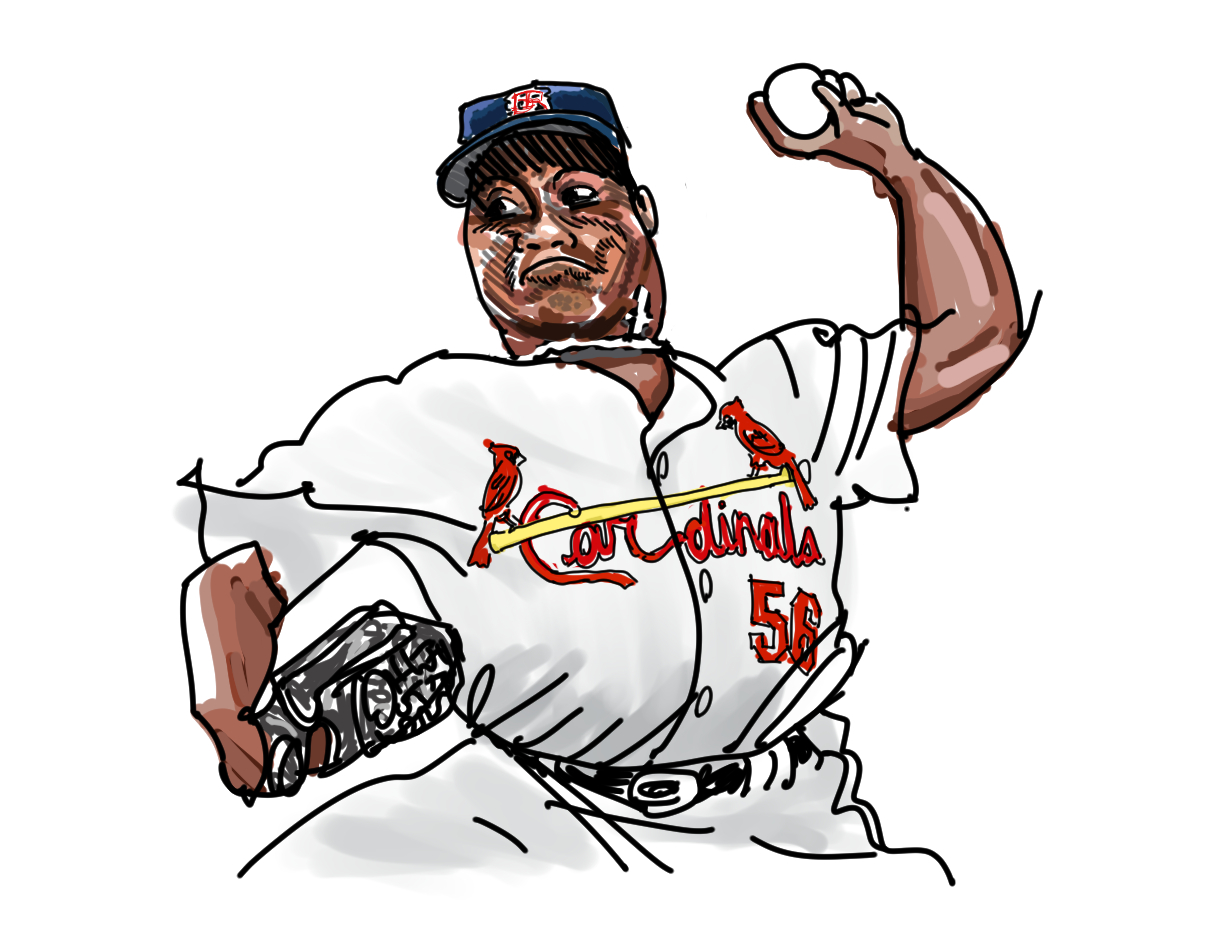
Need to re-do Ray’s head—this looks nothing like him (trying “marker” mode for the first time on the Wacom).
The 2004 Cardinals were the best Cardinals team of my lifetime; their 105 wins are one off the franchise record, and their .648 winning percentage was their second-highest non-WWII mark since joining the National League in 1892, bested only by the 1931 Word Champions who finished 101-53 (.656). [The 1942-44 pennant winners all won at least 105 games and have the three highest winning percentages in team history, but that came during World War II when league competitiveness varied wildly due to depleted rosters from players entering the service.]
The 2004 squad was powered by its offense, with Albert Pujols, Jim Edmonds, and Scott Rolen each having a monster season, and anchored by a solid but unspectacular rotation, with all five primary starters pitching between 188 and 202 innings with an ERA+ between 90 (Matt Morris) and 122 (Chris Carpenter).
Though the hitters were the obvious focus of the team—a nickname for the aforementioned trio was “MV3″—the bullpen was the secret weapon. Jason Isringhausen led the league in saves with 47, and the team featured two pairs of lights-out set-up men, righties Julian Tavarez (19 holds) and Kiko Calero (12 holds), and lefties Steve Kline (15 holds) and Ray King, who led the team with 32 holds.
Sonny Siebert pitched for the Cardinals in his second-to-last MLB season in 1974.
If someone is familiar with 1960s and ’70s pitcher Paul “Sonny” Siebert, the Cardinals are probably not the team that comes to mind. Siebert, who was born in St. Mary, Missouri* on this date in 1937, pitched in the majors from 1964 through 1975, threw 2152 innings and all but 160 came in the American League, mostly with Cleveland and the Red Sox, both for whom he was an All Star.
But late in his career, following his lone season as a Texas Ranger, Siebert was traded to the Cardinals straight up for prospect Tommy Cruz (one of the lesser of the three Cruz brothers), who would accumulate just two plate appearances in the majors. Aged thirty-seven in 1974, Siebert was coming off back-to-back disappointing seasons and was maybe nearing the end of the line when he joined the Cardinal rotation as the fifth starter.
Siebert’s earlier emergence in the mid-’60s as a star pitcher was somewhat unlikely, as he was a basketball standout at the University of Missouri, playing baseball only his junior year—as an outfielder—before he was signed by Cleveland in 1958. He missed the first two months of the 1959 minor-league season with an injury, then, just 61 games after his return, fractured his ankle and missed the rest of the season. During the off-season Florida Instructional League, Siebert, unable to hit or play outfield on the healing ankle, participated by throwing batting practice. His stuff caught the eye of a coach, a former two-time 20-game winner with the Yankees named Spud Chandler, who suggested he had a better path to the majors as a pitcher than a hitter. In 1960 he began his first season as a professional pitcher, for Burlington in the Class B Carolina League, and it took him four years climbing through the minors before he finally made the Cleveland roster, at age 27 in 1964.
For eight seasons, five with Cleveland and then three with the Red Sox, Siebert, while never a superstar or really even a big name, was one of the better pitchers in the American League. In 1965, his first full season in Cleveland’s starting rotation, Siebert went 16-8 and was third in the AL in pitching WAR and second in WHIP and K/9, striking out 191 batters in 188-2/3 innings. (The latter is notable: in the 1960s only four AL starting pitchers had a season averaging at least one strikeout per inning: Siebert; two of his teammates, Sudden Sam McDowell and Luis Tiant; and the Twins’ Dave Boswell.) Siebert followed with double-digit-win seasons through 1972, after which he was dealt to Texas, then to St. Louis.
One memorable highlight of Siebert’s lone season with the Cardinals was on September 11 when he entered the 23rd inning of a scoreless contest in New York that ended up being the longest National League game ever—both by innings and game time. Siebert pitched 2-1/3 innings and was the winning pitcher, striking out John Milner in the bottom of 25th to end the game after Bake McBride had slid home with the only run of the game in the top of the inning.
Despite finishing the 1974 season with very pedestrian numbers—an 8–8 record over 20 starts and 8 relief appearances, with a 3.88 ERA (ERA+ of 94) in 133-2/3 innings—Siebert began dominantly for the Cardinals, throwing a complete-game shutout over the Pirates in his first start and then adding two more while compiling a 1.98 ERA and 6-3 record over his first 11 starts. Arm troubles led to a series of abbreviated shellackings, then to the disabled list. There was a silver lining, though: the Cardinals called up a young righty, Bob Forsch, from AAA Tulsa to take Siebert’s spot while he was on the DL, and Forsch pitched so well he stayed in the rotation, even after Siebert returned, and remained there for 14 years while amassing 163 wins for the Cardinals.
Fun Sonny Siebert fact: In 1971, two years before the adoption of the designated hitter in the AL, Sonny Siebert hit six home runs—only five other pitchers have hit more in a season—and drove in 15 runs while winning 16 games for the Red Sox. He had 1.2 batting WAR that year, along with 5.4 pitching WAR, and finished sixth overall among all AL players in WAR.
Sources: baseball-reference.com and sabr.org
*St. Mary, MO, population 360 (2010 U. S. Census) and located an hour’s drive south of St. Louis, has the distinction of being on the eastern border of Missouri but abutting Illinois—and not the Mississippi River. The river’s flow has changed over the years, and an oxbow that used to divide Missouri and Illinois at St. Mary was filled in, with the river’s new flow further east, in Illinois proper. The former riverbed (technically still known as the Mississippi River), now dry, divides St. Mary from Kaskaskia, IL (population 12), and fills in occasionally during heavy rains.
St. Mary (center bottom) lies on the eastern border of Missouri despite being about 4-1/2 miles west of the Mississippi.
Getting the hang of coloring human skin with the Wacom.
Before there was Mike Tyson, the boxer, there was Mike “Rocky” Tyson, the Cardinals’ scrappy mid-’70s second baseman/shortstop born in Rocky Mount, North Carolina, on this day in 1950. When Garry Templeton took over at shortstop for the Cardinals in mid-1976, part of what made him so exciting is that he was the polar opposite of what the Cardinals had at the position for the previous decade in guys like Tyson, Dal Maxvill, and Don Kessinger—dull, white, slow, and terrible offensively.
Tyson had moved to second base by the time Templeton arrived on the scene, but he was the more-or-less starter at short from 1973–1975, where he led the NL in errors in 1973 with 33, and had the fourth-most in 1974 with 30. Despite all the errors, both baseball-reference and Fangraphs have Tyson as not terrible (a bit below average) at short, and actually decent in 1974. Second base, though, was his “natural” position, but until 1976 he was blocked there by veteran Ted Sizemore, another white, slow, terrible hitter in the middle infield. Garry Templeton had risen quickly through the system, batting .401 in 184 at-bats at AA Arkansas in 1975 after beginning the season in A ball, and was the heir apparent at short; Sizemore, once OK defensively and merely bad at bat, was awful all around in 1975 and on the wrong side of 30, and the Cardinals, needing a change, decided to move Tyson to second for ’76 and acquired the veteran gloveman Don Kessinger from the Cubs to hold down the fort at short until Templeton was ready.
Now the second-base starter for 1976, Tyson singled and tripled in an opening day win over the Cubs, but the next day was injured running to first in his first at-bat, and was out for a month. Returning to the lineup on May 11, he then started each of the next 57 games, suddenly playing like one of the best second baseman in the league, batting .305/.343/.462, with 19 extra-base hits—including 8 triples—and 25 rbi. But on July 18, after homering in his first at-bat to give the Cardinals a 1-0 lead against the Giants, Tyson injured his thumb on a play at second, and missed another six weeks.
When Tyson returned in the second week of September, with the Cardinals far out of contention, Templeton was the starter at shortstop, having been called up in August with Kessinger moving over to second after a couple stopgaps there had proven ineffective. Tyson, at probably less than 100 percent thumb-wise, and Kessinger split time at second for the remaining four weeks while Templeton showed that the anticipation of his arrival had been merited.
Tyson wound up playing just the equivalent of about half a season in 1976, and despite tailing off terribly after his September return, still ended up fifth among all NL second basemen in WAR (bb-ref version), and second, behind MVP Joe Morgan, in OPS plus, at 117. That would represent his career peak, as he never again came anywhere near approaching that level of offensive production. Still, by getting hurt when he did he allowed Cardinals fans a bit of salvation in an otherwise forgettable season by accelerating the debut of Templeton, who would explode in 1977 as one of baseball’s brightest young stars. Alas, his is another story.
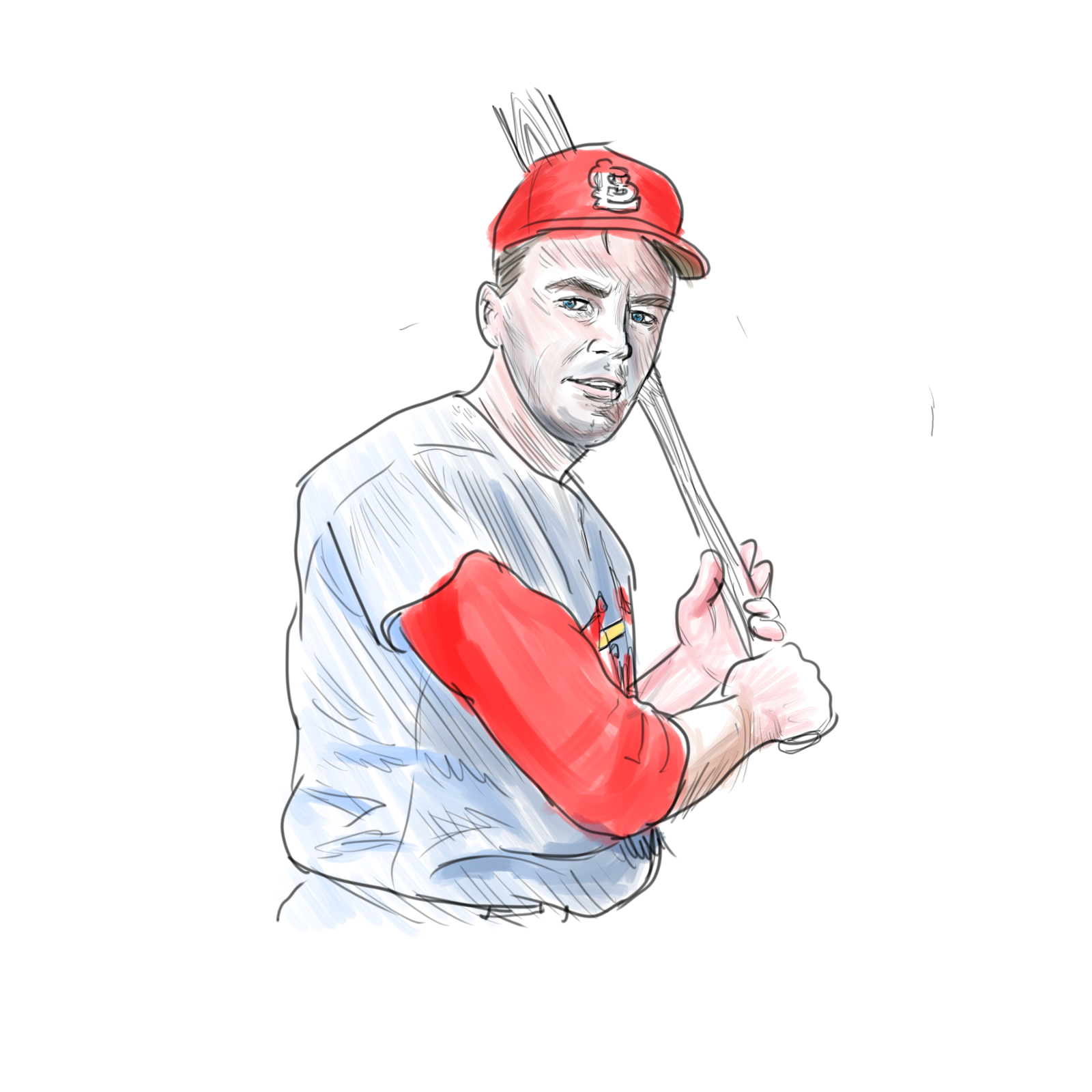
A poor likeness of George Kernek; still getting the hang of the Wacom.
For a few weeks at the beginning of the 1966 season, after five-time all star and six-time defending Gold Glove winner Bill White had been traded to the Phillies but before the May trade with the Giants that brought future MVP Orlando Cepeda to St. Louis, George Kernek was the Cardinals’ starting first baseman. After a good 1965 season in AAA and a respectable showing in a September call-up, Kernek was awarded the job out of spring training in 1966 , with a Cardinal coach saying “He’s a better hitter than people give him credit for being. He has good power.”
Kernek started 15 of the Cardinals’ first 17 games in 1966, hitting .239/.314/.283, with a lone triple accompanying his 11 singles. He was benched on May 2, with veteran Tito Francona (father of Terry, future manager of the Red Sox, Phillies, and Indians) getting the final four starts at first before the May 8 trade for Cepeda, executed while the Giants were in town. Kernek was sent down to AAA Tulsa the same day, and never played in the major leagues again.
My slim connection to Kernek, born this day in 1940, is that his niece and I worked together in the late 1980s at the Daily Illini in Champaign. She learned I was a Cardinals fan, and she mentioned that her uncle played baseball, not just in the major leagues but with the Cardinals. I had never heard of George Kernek, so I looked him up in my Baseball Encyclopedia and lo and behold, there he was, George Kernek. According to the internet, Kernek got into the insurance business back home in Oklahoma, eventually opening his own firm, before retiring in 2009. His niece Lisa is a professor of journalism at Western Illinois University after a long run as a newspaper reporter.
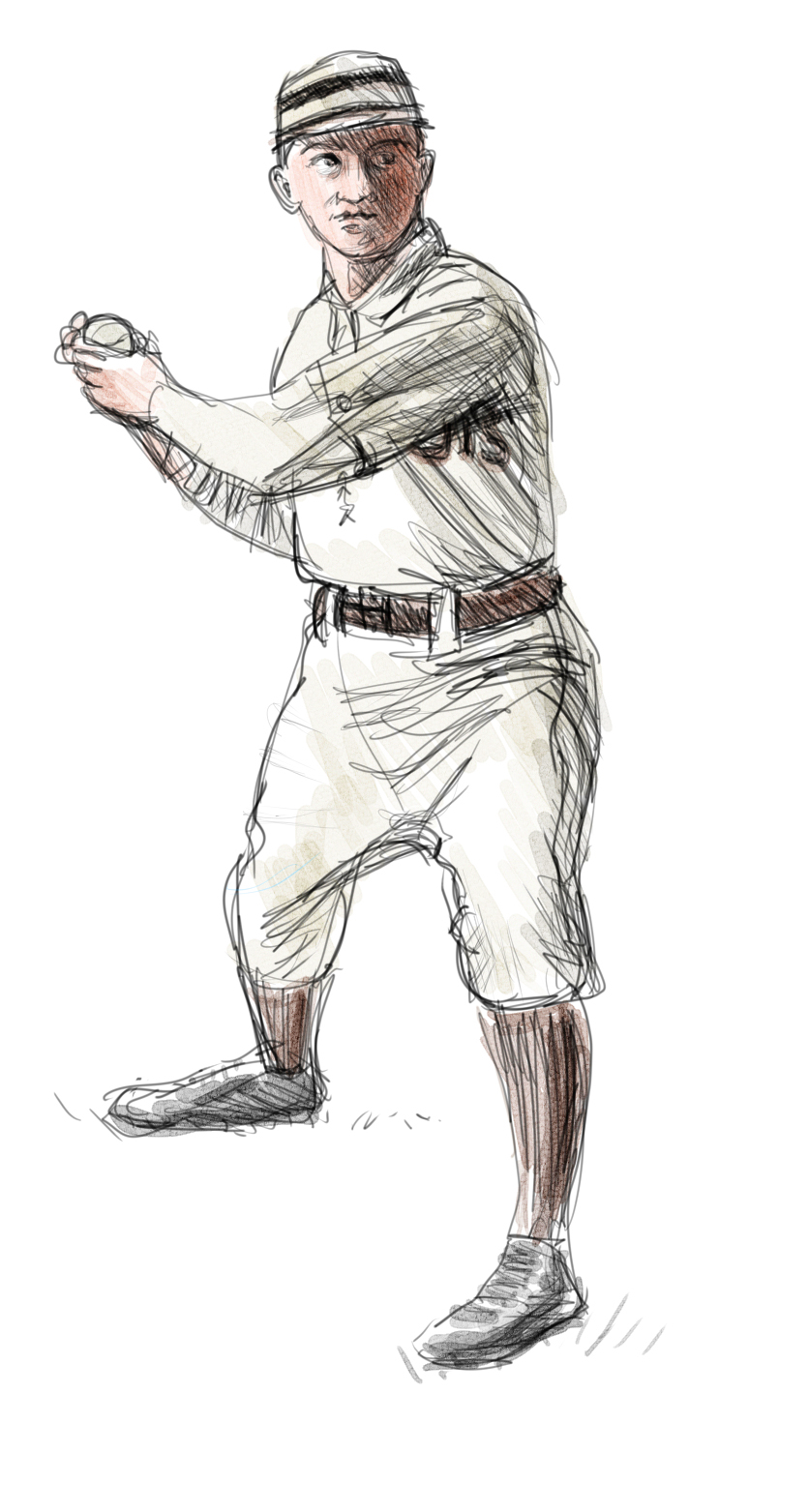
Charles “Silver” King, sketched with my new drawing tablet
Born 133 years ago today, Silver King was the ace of the 1888 American Association Champion St. Louis Browns, putting up insane numbers in an era when an ace pitcher would finish almost every start.
In 1888 King started 64 (47%) of the Browns’ 137 games, and completed all 64 of them, throwing a league-leading 584-2/3 innings. His record was 45-20 for the 92-43 Browns, who lost in the 10-game postseason barnstorming tour against the National League Champion New York Giants, six games to four games. King won just one of his five starts in the series, but only 9 of the 23 runs scored against him were earned so maybe he can blame it on the defense.
His 1888 season, when he was just 20 years old, was the pinnacle of King’s career; he won another 35 games in ’89 (in 53 starts), and the next year jumped to the Chicago Pirates in the upstart Players League (which lasted just one season). He pitched with decreasing effectiveness (and fewer and fewer innings) over the next several seasons in the National League with the Pittsburgh Pirates, Giants, Reds, and Senators, and was out of major-league baseball before his 30th birthday. Which was probably fine with him, because he feuded with almost every team he played on—often about money—and had a successful business in St. Louis as a contractor to fall back on.
Meg was apparently listening when I was at my computer musing about drawing tablets at some point before Christmas, because my big gift from her was a Wacom Cintiq 16-inch “creative pen display” that I’ve just now gotten to playing around with.
My hope is that I experiment with it for at least a couple hours each day and start to generate some art that could be used to liven up this site. We’ll see!
Best thing I’ve read today: Matt Taibbi’s column, “We Need a New Media System,” on his Substack site. I like to read Taibbi and, for similar reasons, Glenn Greenwald, because they remind me of the editorial biases—including my own—that exist everywhere and that I shouldn’t blindly absorb something simply because I may agree with the author’s politics. Greenwald can be off putting at times but I respect his ardent support of press freedom and his calling out of journalistic hypocrisy, which is one point where he and Taibbi converge.
It’s been interesting over the last several months as Taibbi has been unrelentingly criticized on Twitter by commenters questioning his “allegiance” or his journalistic chops (“he used to be good—what happened to him?”) when all he’s been doing is saying that the left shouldn’t criticize the right for things the left also does.
Four nice pitching performances combined to shut out the Reds, 1-0, with Yadier’s homer in the 7th accounting for the game’s scoring.
I kept up with the game at work with my mlb.tv account; quite a difference from the way things were back before the internet, when I remember sneaking down to the TGIFridays’s on the ground floor of the office building I worked in for a couple innings at a time during the 1996 playoffs.
So I was able to fret in real time as Kevin Siegrist and Carlos Martinez had to get five outs in the bottom of the 8th after the defense botched two would-be double plays; Martinez squelched the rally by freezing Todd Frazier with a curveball described by Fangraphs’ Jeff Sullivan as “disgusting” during the site’s Opening Day chatter. I chose the wrong video feed from mlb.tv, as my Reds’ telecast for some reason showed the pitch from the camera located thirty behind and to the left of the home plate umpire.
Wainwright matched zeroes with Johnny Cueto through six, although Cueto was the sharper of the two. That said, neither offense had much of anything going all day, with the Reds’ highlight achievement being the four walks (one intentional) drawn against Wainwright, matching his total through the first five weeks of the 2013 season.
Trevor Rosenthal got the save with a 1-2-3 ninth, including four-pitch strikeouts of Zack Cozart and Brayan Pena to start the inning, and Roger Bernadina ended it with a fly to right on a 2-2 pitch, and after one game the Cardinals are where I expect to see them, in first place.
Every year around opening day I get an itch to do a blog that documents the baseball season in whatever haphazard, episodic form it happens to take, given life’s other priorities, and allows for an expansion of subject matter as I see fit.
So this morning, opening day, I’m walking to the train and I’m thinking about how good the Cardinals might be this year. I think, you know, Jhonny Peralta could have one of the better all-time offensive seasons for a Cardinals’ shortstop: if he’s able to match last year’s OPS+ of 119 it would be the team’s sixth-best in the last 100 years.
And what if Kolten Wong puts up a line of .280/.350/.430, and Matt Adams hits 30+ homers and drives in 100 runs, and Peter Bourjos uses that speed to get 35 doubles and 15 triples while playing a Gold Glove center field… and then I went through the rest of the lineup and then the starting rotation and then the bullpen, and I realized that this could be a historically great Cardinals team. Which I also thought would be a great name for the blog. Which forced me to go ahead and register the name, and one thing leads to another, and now here I am, during lunch at work seeing if I can get something up before the Cardinals’ first pitch of the season later this afternoon.





 Historically Great